Sunday, 19 April 2015

Evaluation 7: Looking back at the preliminary task, what do you feel you have learnt that in the progression to your full product?

Preliminary Task Evaluation


As you can see, I haven't included my double page spread. This is because, I didn't undertake a DPS in the preliminary task because, it wasn't required. Above is a link to the blog post where I evaluated the preliminary task and you can see the contrast from that to my media product now.

In relation to the front cover, I have learnt that an image in which the model is looking at the camera is used on most front covers because, it is as if they are looking at the reader personally. This would immediately draw the reader into the magazine. I have also learnt that a clear colour scheme is an important way of demonstrating what type of music magazine it is. For example, if a colour scheme was pink, purple and yellow, then that would likely mean that it would be a teen pop magazine. I have come to find this through extensive research.

In relation to the contents page, through extensive research, I have learnt that its background plays little part in making it look noticeable to the target audience. I have learnt that it is important to stick with the colour scheme so that the reader isn't confused and can focus on the content in hand. It is also important to advertise loads of features to fill the space and keep the target audience interested enough to read further. If the space isn't filled, then the contents page looks lifeless and uninviting. I have also learnt that it is important to feature an advertisement for a competition for free concert tickets because, the reader can feel like they can benefit from spending money on that magazine.

Evaluation 6: What have you learnt about technologies from the process of conscructing this product?


I only learned about software, whilst constructing my magazine. There are two software programmes that I used heavily during magazine production; Photoshop and Facebook.

In relation to Photoshop, I learned that it is incredibly effective in producing professional magazine front covers of high quality. Photoshop is able to do so because, you are able to use a variety of different coloured boxes (i.e. various shades of one colour). Also, you can use any shape to insert text into, as well as pasting images over one and other. There are also a variety of fonts available, many of which you couldn't use on a Microsoft programme. You are also guaranteed high quality images, no matter how much you increase its original size. I also learned that, with Photoshop, you can create a full magazine within a day, meaning that more can be produced. Many decades ago, it would have been far more difficult to produce copies of one issue, let alone several copies of different issues because, of limited technology back then.

Prior to this task, I didn't have a Facebook account. Subsequently, I have learnt that Facebook is crucial in allowing people from all walks of life, all over the world, to communicate with one and other. This is important because, it allows a range of opinions to be expressed. Without social networking, I have learnt that it would have been difficult for a magazine to gain popularity. This is because, without technology, the message would have been far more difficult to get across to the entire country. This is because, there are areas within the countryside that are effectively isolated from the outside world. Nowadays, Wi-Fi can be accessed anywhere, meaning that information about music magazines is available to anyone, anywhere.

Evaluaion 5: How did you attract/address your audience?


Saturday, 18 April 2015

Evaluation 4: Who would be the audience for your media product?


Evaluaion 3: What kind of media institution might distribute your media product and why?


Evalution 2: How does your media product represent particular social groups?


The postures of both people are slightly similar because, we are both sitting down and it appears that Mark Ronson is looking directly at the camera. However, the positioning of our arms is different. My positioning suggests that I am more serious, whilst Ronson’s suggest that he is carefree. Our facial expressions suggest the same thing. Also, our gestures are differing as well. My gesture suggests that I am ready to face the questions that I was going to be asked. Ronson, on the other hand, appears to be uninterested in answering questions and appears to insist that the interview happens on his terms.

We are both wearing dark clothing, which suggests that the music genre we specialise in is similar (i.e. if I was wearing bright clothing, it would suggest that I would specialise in pop music). Also, my positioning suggests that I am very serious about producing good music for my fans, keeping them interested or perhaps attempting to attract more fans. However, Ronson appears to simply enjoy making music and isn’t actively seeking a fan base. Instead, he appears to allow the reader to make a judgement on whether they will follow him or not and that he wouldn’t care either way.


In conclusion, I think that both images possibly represent the ‘emo/hippie’ social group because, of our dark clothing, the genres of music we specialise in (rock, jazz and funk) and our facial expressions (serious and carefree). The reason why I brought two different social groups together is because, they are both associated with individualism. Both are unique, stand out and often challenge social norms.


Thursday, 9 April 2015

Third Draft (Double Page Spread)


I have now received feedback on my double page spread for my AS Media coursework that will enable me to carry out the third and final draft.

To carry out the third draft, I will rearrange the location of the article title and move it to the left hand side of the page to make my double page spread look more lively and engaging to the target audience. I am also going to ensure that the article text is organized into columns, as it is currently disorganized and it looks slightly unprofessional and more of a powerpoint presentation than a magazine double page spread.
I am also going to improve upon my editing, as you can still sees aspects of the original image.
Below, is the third and final draft of my double page spread. I only made minor improvements to the double page spread because, I was otherwise satisfied with the finished result of the second draft. For the third draft, I managed to cover the unnecessary background of the original image. I also rearranged the text to make the article look more organised.

Wednesday, 1 April 2015

Third Draft (Contents Page)

Before                  After


This is the third and final draft of the magazine contents page for my AS Media coursework.

The feedback from the second draft stated that I simply needed to add more features because, there was some vacant areas that were large enough for more features to be added.

I agreed with the feedback and I indeed, added more features to make the contents page look more lively and to offer the target audience more choice, as you can see in the comparison images above.

Initially, I found it difficult to undertake the third draft because, I was unsure of what to do. However, I was able to recall current up to date artists in the music industry and then, I started to include more features on my contents page. I also changed the date of the issue from November 2014 to the current moth/year, April 2015.


Third Draft (Front Cover)


I have now received feedback that will enable me to complete the third and final draft of my front cover for my AS coursework.

There are only a few changes that I need to make.

For my third draft, I will include a more broad variety of fonts and ensure that the masthead completely dominates the top of the cover. I could possibly remove the dark box and drag the masthead to the other side of the page.

This is the third draft and the improvements that I have made


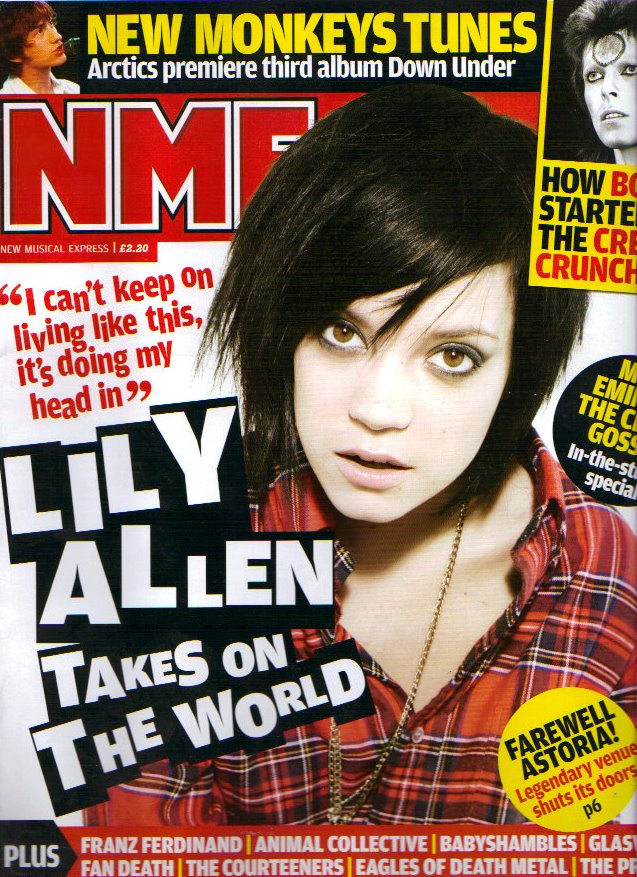
As you can see, I have made several changes to the front cover to make it look more lively. Firstly, I changed the main cover line from red coloured text to white, surrounded by a black box. I decided to make this change after reviewing various front covers from the NME magazine. One particular issue, which had white text surrounded by a black box, which caught my eye, so I decided to use the same format for my main cover line. I also typed the text, using both capitals and small blocks to make it more eye catching to the target audience.
NME

I also included a new section at the bottom of the cover, again to make the cover look more lively and to offer the target audience more to read about. Again, the inspiration from the issue in the image above.
Again to make the magazine look more lively, I enlarged the masthead so that it would dominate the top of the magazine, in order to stand out to the target audience. I also moved all of the sell lines to the left hand side of the page to allow space for other cover lines and images to liven the front cover.